


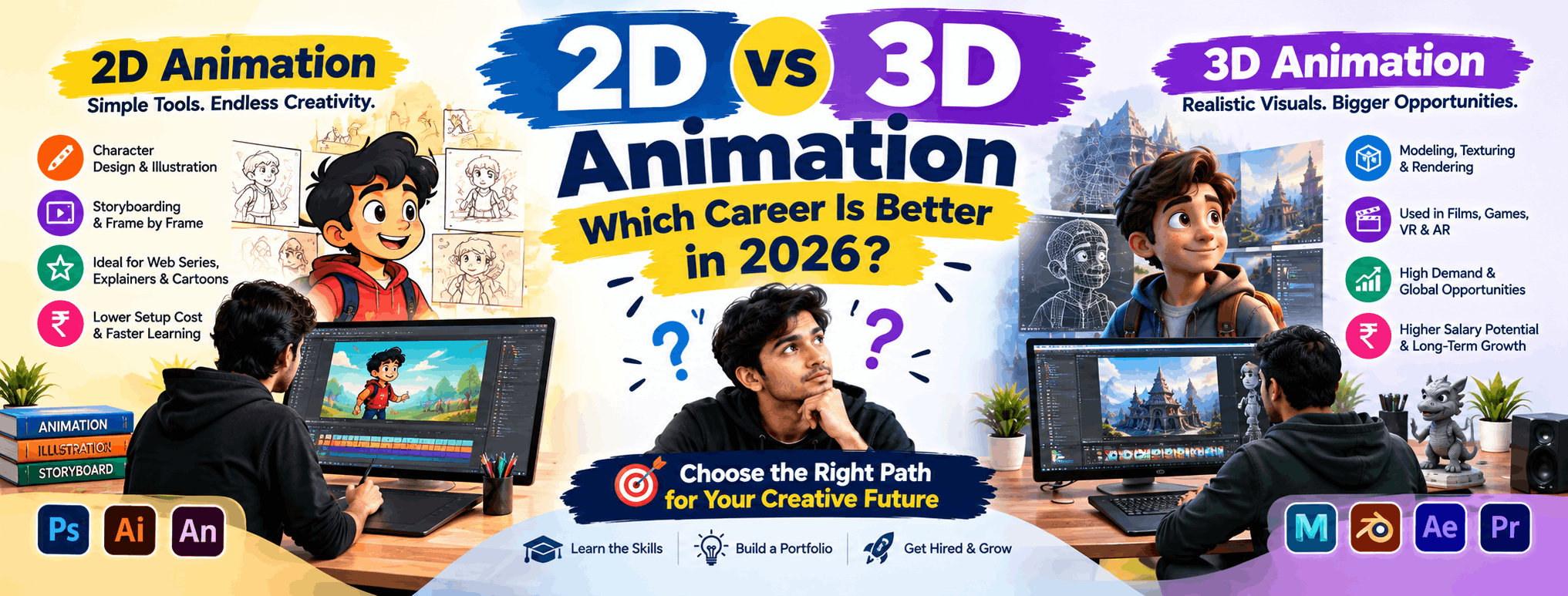
2D vs 3D Animation: Which Career Is Better in 2026?
Animation as a career field has grown far beyond cartoons and movies. Today it powers ads, mobile games, product explainers, architectural walkthroughs, and even educational content. If you are trying to decide between 2D and 3D animation as a career, you are probably wondering which one has better job prospects, which is easier to learn, and which suits your creative interests. This article breaks down both paths in detail - the skills required, tools used, learning curve, portfolio expectations, and job opportunities - so you can make an informed decision for 2026 and beyond, instead of guessing based on trends alone.
What Is 2D Animation?
2D animation involves creating movement using flat, two-dimensional characters and backgrounds. It is the traditional animation style used in cartoons, explainer videos, mobile game interfaces, and social media content. Modern 2D animation is done digitally using software rather than hand-drawn frames, though the core principles of movement and timing remain the same.
2D animation is widely used in:
- Explainer and marketing videos for businesses
- YouTube animated content and web series
- Mobile game UI and character animation
- Educational and e-learning videos
- Motion graphics for social media
What Is 3D Animation?
3D animation involves creating characters, objects, and environments with depth (height, width, and length) using specialised software. These models can be rotated, lit, and animated to look realistic or stylised. 3D animation is commonly used in films, video games, product visualisation, and architectural presentations.
3D animation is widely used in:
- Feature films and VFX-heavy content
- Video game character and environment design
- Product modelling and advertising
- Architectural walkthroughs and real estate previews
- Medical and technical visualisation
2D vs 3D Animation: Quick Comparison
| Factor | 2D Animation | 3D Animation |
|---|---|---|
| Learning curve | Comparatively easier to start | Steeper, more technical concepts involved |
| Core skills | Drawing, timing, storytelling | Modelling, rigging, lighting, rendering |
| Common software | Adobe Animate, Toon Boom Harmony, After Effects | Blender, Autodesk Maya, Cinema 4D, 3ds Max |
| Hardware needs | Works well on standard laptops/tablets | Needs a higher-spec PC with a good GPU |
| Main industries | Marketing, e-learning, social media, mobile apps | Films, gaming, architecture, product visualisation |
| Project turnaround | Generally faster for short content | Takes longer due to modelling and rendering time |
| Freelance demand | High for short-form business videos | High for specialised, longer projects |
Skills You Need for a 2D Animation Career
- Strong understanding of drawing fundamentals and character posing
- Knowledge of animation principles like timing, spacing, and squash-and-stretch
- Storyboarding and basic storytelling ability
- Comfort with vector-based and frame-by-frame animation tools
- Ability to work with sound and simple motion graphics
Skills You Need for a 3D Animation Career
- 3D modelling and texturing basics
- Rigging (creating a digital "skeleton" for characters)
- Lighting, camera work, and rendering knowledge
- Patience for technical troubleshooting, as 3D software has a learning curve
- Basic understanding of physics for realistic movement
Which Tools/Software Should You Learn?
For 2D animation, beginners usually start with Adobe Animate or Toon Boom Harmony for character animation, and Adobe After Effects for motion graphics and explainer videos. For 3D animation, Blender is a popular starting point because it's free and powerful, while Autodesk Maya and 3ds Max are widely used in studios for film, game, and product visualisation work.
It's worth noting that many professionals eventually learn both a 2D tool and a 3D tool, since real-world projects (like ads or game trailers) often mix flat graphics with 3D elements.
Building a Portfolio: What Actually Gets Noticed
Whether you choose 2D or 3D, your portfolio matters more than your certificates. A few practical tips:
- Include 4-6 strong pieces rather than 20 average ones.
- Show variety: a character animation, a short story-based clip, and one commercial-style piece (like a product ad or explainer).
- Add short breakdowns explaining your process - this shows employers you understand the "why," not just the "how."
- For 3D, include turntable renders of your models so recruiters can see the model from all angles.
- Keep your show reel under 90 seconds; recruiters rarely watch longer reels fully.
Common Mistakes Beginners Make
- Jumping into advanced 3D software before understanding basic animation principles.
- Copying tutorials exactly without adding a personal creative touch.
- Ignoring sound design and timing, which make animation feel alive.
- Building a portfolio with unfinished or overly similar pieces.
- Not specialising - trying to be a generalist too early instead of building one strong skill first.
Learning Path: How to Start in 2026
- Learn the 12 principles of animation - these apply to both 2D and 3D.
- Pick one path (2D or 3D) based on your interest, not just trends, and commit to it for at least a few months.
- Master one core software tool deeply rather than jumping between many.
- Work on small personal projects - a 10-second character walk cycle, a short logo animation, or a simple product render.
- Get feedback from mentors or experienced animators and revise your work.
- Build a focused portfolio and start applying for internships or freelance projects.
If you prefer structured classroom learning with guided feedback instead of learning everything alone online, a course like the Video Editing or Graphic Design programs at Graphic Design Institute can help you build these fundamentals with practical, hands-on projects rather than just theory.
Job and Freelance Opportunities
Both 2D and 3D animators find work across similar categories, though the nature of projects differs:
- In-house roles: Animation studios, ad agencies, game studios, and e-learning companies hire animators for ongoing production work.
- Freelance work: Businesses frequently need short explainer videos, social media animations, and product visuals - this is a strong area for both 2D and 3D freelancers.
- Specialised roles: 3D skills open doors to architectural visualisation, game asset creation, and product rendering for e-commerce brands.
- Hybrid roles: Many studios now prefer animators who understand both 2D motion graphics and basic 3D elements for mixed-media projects.
Rather than asking "which pays more," it's more useful to ask "which type of work do I enjoy creating," since consistency and skill depth usually matter more for long-term growth than the format itself.
So, Which Should You Choose in 2026?
If you enjoy drawing, storytelling, and want quicker project turnaround with lower hardware requirements, 2D animation may suit you better as a starting point. If you're drawn to realism, gaming, films, or visualisation work and don't mind a steeper technical learning curve, 3D animation could be the better long-term investment. Many successful animators eventually pick up both, using 2D for concept and storytelling and 3D for final polished output. The "better" career genuinely depends on your interest, patience for technical work, and the industry you want to enter.
FAQs
Is 2D animation easier than 3D animation to learn?
Generally, yes. 2D animation has a shorter learning curve because it relies more on drawing and timing skills, while 3D animation involves additional technical steps like modelling, rigging, and rendering. However, mastering either one to a professional level still takes consistent practice over months, not weeks.
Do I need a powerful computer for 3D animation?
Yes, 3D animation software like Blender or Maya requires a decent GPU and RAM to handle modelling and rendering smoothly. 2D animation software is comparatively lighter and can run on standard laptops, making it more accessible for beginners with basic systems.
Can I switch from 2D to 3D animation later in my career?
Yes, many animators start with 2D to understand core principles like timing and movement, then transition into 3D once they're comfortable. The animation fundamentals carry over; you'll mainly need to learn new software and technical processes for 3D work.
Which animation field has more freelance opportunities?
Both fields offer freelance work. 2D animation freelancers often get short-term projects like explainer videos and social media content, while 3D freelancers are sought for product renders, architectural walkthroughs, and game assets. Availability depends more on your portfolio and niche than the format itself.
Do I need to know drawing to become an animator?
Basic drawing skills help, especially for 2D animation and storyboarding, but they aren't mandatory for every animation role. Many 3D animators focus more on software skills, movement, and composition rather than freehand drawing ability.
How long does it take to become job-ready in animation?
This varies by individual effort and prior design experience, but most learners need consistent practice over several months to build a portfolio strong enough for internships or freelance work. Structured courses with mentorship and project feedback can often help you progress faster than self-study alone.
Is animation a good career choice with AI tools growing?
AI tools are changing parts of the animation workflow, like speeding up rough drafts or in-betweening, but they still rely on skilled animators to guide creative decisions, storytelling, and quality control. Understanding animation fundamentals remains valuable regardless of which tools you eventually use.
About Graphic Design Institute
Graphic Design Institute (GDI) is a training institute based in Rohini, Delhi, offering practical, project-based courses in Graphic Design, Video Editing, Web Design, Web Development, Digital Marketing, AutoCAD 2D & 3D, and Data Analytics. GDI focuses on hands-on learning and portfolio building to help students develop industry-relevant creative and technical skills.
If you're exploring a career in animation-related design and want guided, classroom-based training in Rohini, Delhi, it may be worth speaking with GDI's team about the right course for your goals.
Interested in learning more? Explore our Graphic Design course or register now for a free demo class at Graphic Design Institute.