



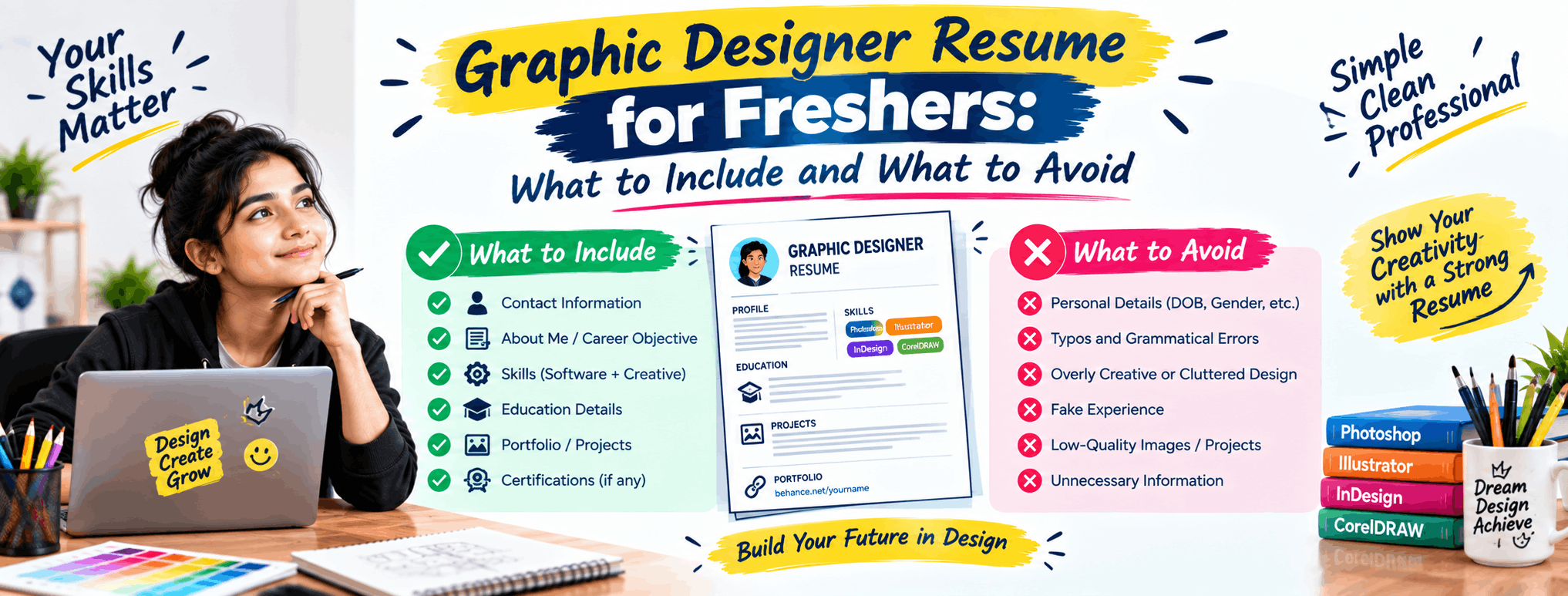
Graphic Designer Resume for Freshers: A Complete Guide
Writing your first graphic designer resume can feel confusing, especially when you have limited work experience to show. Recruiters spend only a few seconds scanning each resume before deciding whether to move forward, so every line needs to earn its place. This article breaks down exactly what a graphic designer resume for freshers should include, which common mistakes quietly hurt your chances, and how to present your skills and portfolio in a way that feels professional and job-ready. Whether you are a design graduate or someone who has completed a certification course, these practical tips will help you build a resume that actually gets noticed.
Why a Fresher Graphic Design Resume Is Different
Unlike experienced professionals, freshers don't have years of client projects or job titles to lean on. Your resume needs to shift focus from "where I worked" to "what I can do." This means your software skills, academic projects, personal design work, and portfolio link carry much more weight than they would for a senior designer. Recruiters hiring freshers are usually looking for potential, creativity, and a solid grasp of design fundamentals rather than a long work history.
What to Include in a Graphic Designer Resume for Freshers
1. A Clear Contact Section and Portfolio Link
Start with your full name, phone number, email address, and city. Always include a link to your online portfolio, Behance profile, or personal website. If you don't have one yet, treat building it as your first priority before applying anywhere, since most hiring managers will skip resumes without visible work samples.
2. A Short, Specific Career Objective
Skip generic lines like "seeking a challenging position in a reputed organisation." Instead, write two to three lines that mention your specialisation and intent. For example: "Fresher graphic designer with strong skills in Adobe Photoshop and Illustrator, seeking an entry-level role in branding and social media design where I can apply my visual storytelling skills."
3. Technical Skills and Software Proficiency
List the tools you're comfortable with, such as:
- Adobe Photoshop, Illustrator, InDesign
- Canva or Figma (for social media and UI-style layouts)
- CorelDRAW (if used during training)
- Basic understanding of typography, colour theory, and layout design
Be honest about your skill level. If you've only used a tool for coursework, mention it as "working knowledge" rather than "expert."
4. Education and Relevant Certifications
Mention your highest qualification along with any design-related diploma or certification course. If you've completed structured training, such as a graphic design course covering branding, print design, and digital design tools, include the institute name, course name, and duration.
5. Academic and Personal Projects
This section often matters more than education for design roles. Include 3-5 projects such as:
- A logo or brand identity project
- A social media creative series
- A poster or brochure design
- A packaging or magazine layout concept
For each, add a one-line description of the brief and the tools used. This shows recruiters how you think through a design problem, not just how the final output looks.
6. Internships or Freelance Work (If Any)
Even short-term internships, college fest design work, or small freelance projects for local businesses count. Mention the client or organisation, what you designed, and the outcome if measurable, like "designed Instagram creatives for a local bakery's product launch."
7. Soft Skills That Matter for Design Roles
Include a few relevant soft skills such as attention to detail, time management, ability to take feedback, and collaboration. Avoid listing generic traits without context; instead, tie them to design work wherever possible.
What to Avoid in Your Resume
Many freshers unknowingly weaken a strong skill set with avoidable resume mistakes. Watch out for these:
- Overly decorative resume design: A resume that's too colourful or cluttered can distract from the content. Keep the layout clean, with your creativity reserved for the portfolio.
- No portfolio link: A graphic design resume without visible work samples rarely gets shortlisted.
- Vague skill statements: Phrases like "creative thinker" or "hardworking" mean little without proof or examples.
- Spelling and grammar errors: For a visual profession, small errors can suggest a lack of attention to detail.
- Irrelevant personal details: Avoid adding things like religion, marital status, or a lengthy hobbies list unless directly relevant.
- Using low-resolution or generic templates: If you're designing your own resume layout, make sure it reflects the same design quality you'd apply to client work.
- Listing every software you've ever opened: Stick to tools you can actually demonstrate skill in during an interview or test.
Portfolio Building Tips for Freshers
Your portfolio often matters more than the resume itself. A few practical tips:
- Include 8-12 of your strongest projects rather than everything you've ever made.
- Show variety: branding, print, digital, and at least one packaging or UI-style project if possible.
- Add short case studies explaining the brief, your process, and the final result.
- Keep file sizes optimised so your portfolio loads quickly on mobile and desktop.
If you're still building your portfolio, working on real or simulated client briefs during a structured course can help you create presentable, varied work rather than random practice files.
Learning Path: From Beginner to Job-Ready
A typical learning path for someone starting fresh in graphic design usually includes:
- Learning design fundamentals: layout, colour theory, typography
- Getting hands-on with Adobe Photoshop, Illustrator, and InDesign
- Practising real-world briefs like logos, brochures, packaging, and social media creatives
- Building a portfolio alongside coursework instead of after finishing it
- Applying for internships or small freelance projects to gain practical exposure
If you want structured classroom training and guided learning instead of piecing things together on your own, GDI's Graphic Design course is designed around this exact progression, moving from software basics to portfolio-ready projects with instructor feedback.
Freelance and Job Opportunities for Fresher Designers
Freshers usually start in one of a few ways: entry-level in-house design roles at agencies or companies, internships that convert into full-time positions, or freelance projects picked up through personal networks and online platforms. Freelancing can be a good way to build your portfolio and confidence early on, though it often works best alongside some structured learning so your work meets professional standards from the start.
FAQs
Do I need work experience to apply for graphic design jobs as a fresher?
No, most entry-level roles don't require prior work experience. What matters more is a solid portfolio, clear understanding of design software, and the ability to explain your design decisions during an interview.
How long should a fresher graphic design resume be?
One page is usually sufficient for freshers. Recruiters prefer concise resumes that highlight relevant skills and projects clearly, without unnecessary filler content.
Should I design my own resume or use a simple template?
Either works, as long as it's clean and easy to read. A well-designed resume can showcase your skills, but only if it doesn't compromise readability or make important information hard to find.
What if I don't have any real client projects yet?
Use academic assignments, self-initiated projects, or mock client briefs. Recruiters understand freshers may not have real clients yet, but they still want to see thought process, creativity, and technical skill.
Is it necessary to include a career objective?
It's optional but helpful when written specifically. A short, targeted objective can quickly tell recruiters what role you're aiming for and what you bring to it, saving them time.
Which software skills are most important to mention?
Adobe Photoshop and Illustrator are considered essential, with InDesign useful for print-related roles. Depending on the job, familiarity with Figma or Canva can also be a plus, especially for social media or UI-focused positions.
How can I make my portfolio stand out as a fresher?
Focus on quality over quantity, show varied project types, and add brief explanations of your design process. A well-organised portfolio with 8-12 strong pieces usually works better than a large collection of average work.
About Graphic Design Institute
Graphic Design Institute (GDI), based in Rohini, Delhi, offers practical, project-based training in Graphic Design, Video Editing, Web Design, Web Development, Digital Marketing, AutoCAD 2D & 3D, and Data Analytics. The institute focuses on hands-on learning with industry-relevant software and tools, helping students build a genuine portfolio alongside their coursework.
If you're preparing for your first design job and want guided training to strengthen both your skills and your resume, it may be worth exploring GDI's Graphic Design course in Rohini, Delhi.
Interested in learning more? Explore our Graphic Design course or register now for a free demo class at Graphic Design Institute.