



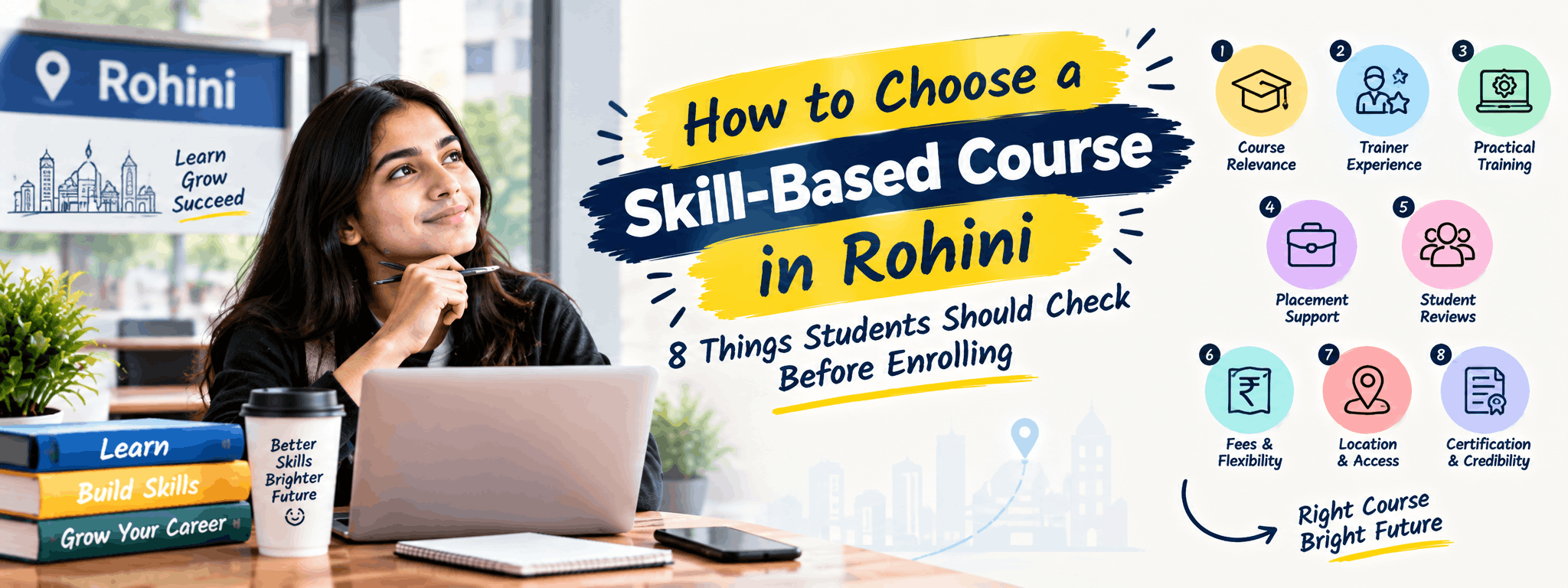
How to Choose a Skill-Based Course in Rohini
Rohini has become one of Delhi's busier education hubs, with dozens of institutes advertising courses in graphic design, digital marketing, web development, and more. For students and working professionals, this is good news - more options - but it also makes choosing the right one confusing. A flashy website or a low course fee doesn't always mean quality training. Before you enrol anywhere, it helps to know exactly what to look for. This article breaks down eight practical checkpoints that can save you money, time, and frustration when selecting a skill-based course in Rohini, along with common mistakes students make and questions worth asking before you pay a single rupee.
Why Choosing the Right Skill-Based Course Matters
Skill-based courses are different from traditional degree programs. Their entire value lies in whether they make you job-ready or freelance-ready within a defined period. A wrong choice means wasted months, and in a competitive job market, that time matters. Unlike a three-year degree where you have room to explore, a 3-6 month skill course needs to deliver focused, practical outcomes quickly. That's why the checklist below focuses on real, verifiable factors rather than marketing promises.
1. Check the Detailed Course Curriculum, Not Just the Course Name
Many institutes list a course name like "Digital Marketing" or "Web Development" without sharing what's actually taught. Ask for a module-wise breakdown.
- Does the curriculum match current industry tools and trends?
- Is there a mix of theory and hands-on practice?
- Are advanced topics covered, or just the basics?
For example, a graphic design course should ideally cover typography, colour theory, branding, and software like Adobe Photoshop and Illustrator - not just "how to use software" without design fundamentals.
2. Verify Trainer Experience and Teaching Approach
The trainer matters more than the institute's interior design. Before enrolling, ask:
- Does the trainer have real industry experience or only academic background?
- Will the same trainer take the entire course, or will it change midway?
- Can you sit in on a demo class before paying the full fee?
A good trainer explains concepts with live examples and current industry practices, not just textbook definitions.
3. Look at Batch Size and Practical Training Time
Skill-based learning depends heavily on individual attention. A batch of 40-50 students in one room usually means less hands-on guidance. Ask about:
- Average batch size for the course you're interested in
- Ratio of lecture time versus practical/lab time
- Access to computers, software, or tools during class hours
Courses like AutoCAD 2D & 3D, video editing, or web development need consistent lab practice, not just theory sessions.
4. Ask About Projects and Portfolio Building
Certificates alone don't get interviews - a strong portfolio does. Before joining, ask whether the course includes:
- Live or simulated projects you can showcase later
- Guidance on building a portfolio website or profile (Behance, GitHub, etc., depending on the field)
- Feedback sessions on your project work
For fields like graphic design, web design, and video editing, a portfolio often matters more to employers than the certificate itself.
Common Mistake: Choosing a Course Only Because It's Cheap
Low fees can be tempting, but if the institute cuts corners on trainers, systems, or practical exposure, you end up spending more later on another course to actually become job-ready. Compare value, not just price.
5. Understand the Certification and Its Recognition
A certificate should reflect the skills you've actually learned. Ask:
- Is the certificate issued by the institute, an affiliated body, or a software company?
- Is it accepted by local employers, freelance clients, or agencies in Delhi NCR?
- Does the certification process include a practical assessment, or is it given automatically after attendance?
Don't assume a certificate name alone makes you employable - it's the skill behind it that counts.
6. Check Placement Support and Career Guidance Honestly
Be cautious of institutes that guarantee jobs or promise fixed salary figures - genuine training centres avoid such claims because hiring depends on many factors, including your own effort, interview performance, and market conditions. Instead, ask specific questions:
- Does the institute offer resume-building or interview preparation support?
- Are there tie-ups or referrals to companies, even if not guaranteed placements?
- Can you speak to a few past students about their experience?
Reasonable placement assistance and guidance are valuable; guaranteed jobs are a red flag.
7. Compare Course Duration, Flexibility, and Schedule
Skill courses vary widely in duration and pacing. Check whether the institute offers:
- Weekday and weekend batches for working professionals or students
- Fast-track versus standard-paced options
- Makeup classes if you miss a session
Our team can share exact details on course duration and batch timings for specific programs like Data Analytics, Web Design, or Digital Marketing when you enquire directly.
Quick Comparison: What to Ask For vs What to Avoid
| Check This | Avoid This |
|---|---|
| Detailed, written curriculum | Vague course names with no syllabus |
| Trainer's real project/industry background | No information shared about trainers |
| Practical project-based learning | Only theory-based classroom sessions |
| Honest placement guidance | "100% guaranteed job" promises |
| Small or medium batch sizes | Overcrowded classrooms with shared systems |
8. Visit the Institute in Person and Ask for a Trial Class
Photos on a website can be misleading. If the institute is based in Rohini, Delhi, it's worth visiting in person to check the actual classroom setup, computer systems, software availability, and overall learning environment. A short trial or demo class can tell you more about teaching quality than any brochure. This step alone helps many students avoid a wrong decision.
How This Applies Across Different Skill Courses
Whether you're considering Graphic Design, Video Editing, Web Design, Web Development, Digital Marketing, AutoCAD 2D & 3D, or Data Analytics, the same eight checkpoints apply. The tools and syllabus will differ, but the fundamentals of a good institute - clear curriculum, experienced trainers, practical exposure, honest guidance, and a real learning environment - stay the same. If you want structured classroom training with guided, hands-on learning across these skill areas, GDI's course offerings in Rohini may be worth exploring as part of your research.
FAQs
How do I know if a skill-based course is worth the fee?
Compare the curriculum depth, trainer quality, and practical project work against the fee charged. If two institutes offer similar fees but one gives more hands-on training and portfolio support, that's usually the better value, not necessarily the cheaper option.
Should I choose weekday or weekend batches?
It depends on your current commitments. Students with school or college can consider weekend or evening batches, while those with more free time may prefer weekday batches for faster progress. Ask the institute if both options are available before enrolling.
Is a certificate enough to get a job after a skill course?
A certificate helps, but employers usually care more about what you can actually do. A strong portfolio, practical project experience, and interview readiness matter as much as, or more than, the certificate itself.
How important is batch size in a skill-based course?
Very important. Smaller batches usually mean more individual attention, more system/software access time, and better doubt-clearing during practical sessions, especially for software-heavy courses like AutoCAD, video editing, or web development.
What red flags should I watch for before enrolling?
Be cautious of institutes that guarantee jobs, avoid sharing a detailed syllabus, don't allow a trial class, or pressure you to pay the full fee immediately without answering your questions clearly.
Can I switch courses if I choose the wrong one initially?
Some institutes allow switching within a short window if you haven't progressed far into the course, but this varies. It's better to ask about this policy before enrolling rather than assuming it's possible later.
Do I need prior technical knowledge before joining a skill course?
Most beginner-level skill courses, such as those in graphic design or digital marketing, don't require prior technical knowledge. However, some advanced or specialised modules may expect basic computer familiarity, so it's worth checking the prerequisites in advance.
About Graphic Design Institute
Graphic Design Institute (GDI) is a training institute based in Rohini, Delhi, offering practical, classroom-based courses in Graphic Design, Video Editing, Web Design, Web Development, Digital Marketing, AutoCAD 2D & 3D, and Data Analytics. The institute focuses on hands-on learning, structured curriculums, and guided support to help students build real, usable skills. If you're evaluating your options for a skill-based course in Rohini, feel free to reach out to GDI's team to discuss curriculum details, batch timings, and course structure.
Interested in learning more? Explore our Digital Marketing course or register now for a free demo class at Graphic Design Institute.